Kamis, 19 April 2018

How Illegal Fee Sharing May Cost You Your New York Medical License

How Illegal Fee Sharing May Cost You Your New York Medical License

Image source: http://www.urban75.org/blog/images/comacchio-ferrera-italy-13.jpg

How Illegal Fee Sharing May Cost You Your New York Medical License

What does New York Law Say About Medical Fee Splitting?

Generally, New York law bans fee splitting in the practice of medicine. This prohibition applies to both corporate and individual settings. Specifically, New York Public Health Law section 4501(1) expressly forbids both businesses and individual practitioners to practice medicine for profit in a manner that includes "the referral or recommendation of persons to a physician, dentist, hospital, health related facility, or dispensary for any form of medical or dental care or treatment of any ailment or physical condition." The law also prohibits physicians and other health care professionals and facilities "to accept for medical or dental care or treatment any person referred or recommended for such care or treatment by a medical or dental referral service business located in or doing business in another state if the medical or dental referral service business would be prohibited... if the business were located in or doing business in New York." In simple words, it is prohibited to give or accept fees for patient referrals.

Does the law make any distinction between individual and corporate practice of medicine when it comes to sharing fees?

In New York, businesses and non-profits organizations are not allowed to practice medicine per se unless they are so certified by the Public Health Council. Therefore, any New York physician who shares or allows others to share in the fees for medical services with a business entity will be disciplined under NY Education Law section 6530(19). Illegal fee-sharing involving business entities may take many forms. For example, in a recent case, the court held that payment of a portion of physicians' income from their private clinic practice to a university as a condition of the physicians' employment with the university was an illegal fee-splitting arrangement where the physicians were not employees of the university faculty practice corporation, and the university was not providing the physicians with salary, employee benefits, facilities, supplies, staff, or malpractice insurance. (Odrich v Trs. of Columbia Univ.) Illegal fee-splitting does not always involve money payments. Giving or receiving any valuable benefit such as credit, omission, discount, gratuity, etc. may qualify as fee sharing.

So what is corporate practice of medicine or illegal fee splitting?

By way of example, several court cases demonstrate corporate practice of medicine and illegal fee splitting. In one case, a doctor entered into an agreement with his technicians that provided that the technicians would perform EEG and ECHO tests and the doctor would pay them 50 percent of the fees for the tests. In another case, a corporation employed doctors and provided them with office space and equipment in exchange for a percentage of their income. Another example is one of a physician who had his license suspended for paying referral fees to a women's health center that had been referring to him patients for abortions.

Are there any exceptions?

Yes. The law permits physicians to practice medicine and share fees through partnerships, professional corporations, university faculty practice plans, hospitals, HMOs, and employee/student health programs. While permitted, such arrangements are subject to limitations. For example, a physician who is not a member of a partnership may not share fees with the partnership. What about paying salaries to employees? Paying salaries to employees is not illegal fee sharing unless the salaries are contingent on the physician's income and are a certain percentage of the income. Fee sharing with another physician is permitted under certain circumstances, such as in the case with a consultant or professional subcontractor.

Is it a problem for a physician to employ a billing company or a collection agency?

That depends on the type of the agreement between the physician and the billing company. By default, many billing businesses prefer a contingency-based model where they charge the doctor a percentage of the doctor's income. While permissible for the billing companies, such practice is a sure way to professional discipline for the physician. The right way would be to arrange for a fixed rate representing fair market value of the services. However, this is different with the collections agencies. Paying collections agencies on a contingency basis depending on the amount recovered is not illegal fee-splitting.

What are the legal consequences of violating the fee-splitting laws and corporate practice of medicine?

In the latter case, since businesses are not allowed to practice medicine, such practice is considered "unlicensed practice of medicine", which is a class E felony. If convicted, the defendant may serve between one to four years in prison and incur monetary penalties. The entity itself will be dissolved. Physicians who enter into contracts with unlicensed business entities may be charged with fraudulent practice of medicine or practicing beyond authorized scope and be subjected to professional discipline. Illegal fee-splitting is a professional misconduct and any physician found to have violated the fee sharing rules will be disciplined.

Rabu, 18 April 2018

How Does Diversity In The Workplace Affect You

How Does Diversity In The Workplace Affect You

Image source: http://dynamicmanagement.theblogpress.com/files/2015/03/Mosaic-Workplace-Cultures.jpg

How Does Diversity In The Workplace Affect You

I know that diversity in the workplace has been a big topic of conversation ever since the early 1990s when research supported the demographics that, by the year 2000, 85% of the entering workforce would be female, African-American, Asian-American, Latino, or new immigrants. The fact that white males would be a minority entering the workplace was a wake up call for corporate America. How have we done since then?

I suggest that there has been definite improvement in the area of hiring but it seems that once women and minorities are hired, there are informal, relatively unconscious systems in place that prevent advancement of the minority worker or women, even today. If there is to be a true advancement in the area of valuing diversity, then the system must be revised so that there truly is equal opportunity for advancement for everyone, including the white male.

I am not advocating for a system that promotes workers who are incompetent to meet some type of quote system. What I am suggesting is that management begins to closely examine the formal and informal systems that are in place that prevent advancement by women and minorities. Of course this is a monumental task and many would like to believe that it is unnecessary---that there is no problem here. That is part of the problem. On the surface, it seems that things or improving, however, under close scrutiny there are many flaws.

Why would a company make a commitment to this self-introspection? Wouldnt it make things worse before they got better? The answer to the second question is quite possibly yes. The answer to the first question is bottom line dollars and cents, as well as the fact that it is the humanitarian thing to do.

America is a multicultural nation that is becoming more multicultural daily. That is a reality. Unless a company intends to market and sell to only mainstream America, the contributions of minorities and women in the workplace are invaluable. This does not even begin to touch on the advantages of diversity for the global market!

Addressing the diversity issue is a three-part one.

The first step is what I call Awareness.

This is a time for individual self-reflection for each member of the workforce. There are many skilled training programs available that are designed to raise the awareness of the individual. If this step is missed, then taking the next two steps will be ineffective.

Individuals must develop a certain amount of empathy and understanding for the experience of being a minority in the country. With this empathy and understanding, a new motivation will develop to learn more and to be in tune with the needs of female and minority workers on the job. Even those who believe that they are aware and knowledgeable will be surprised at how much they really dont know.

The second step involves honoring, respecting and valuing the diversity of each individual.

Diversity is so much more than race and ethnicity. It has been defined as a total way of life and is learned. Take a white person and have him raised by African-American parents, and his culture will be that of African-American. Conversely, a black child raised by Caucasian parents will have a Caucasian culture.

President Barack Obama is another example. Here we have the child of a black father and white mother who was raised primarily by his white grandparents and white mother. He is "diversity personified." Yet, mainstream media continues to portray him as "the first Black-American President of the United States". Media perpetuates racial division rather than promoting racial blindness. How will we ever move forward?

When difference is truly honored, respected and valued, no longer are people concerned about who is right and who is wrong. There is a place for everything and no one is wrong. What works best in one situation may not work best in another. Everyones opinion is valued. Instead of shutting down when differing views are expressed, the new paradigm is to listen for the wisdom in the difference and the means to incorporate it into the way things are currently done for the good of all.

The final, and perhaps the most difficult, stage is to examine the systems that are already in place. One of the systems that has continually been blamed is that to get along in the world of work, women and minorities need to act like white males. It is this acculturation that will currently get a person ahead.

This is fine in the short run for the company, however, in the long run, when embracing difference, having workers who are comfortable with their own culture and can bring with them the advantages and benefits from that culture into the workplace is invaluable. Also, setting it up so minorities and females realize that they must acculturate on the job is not a good thing for the worker. People want to be their authentic selves in all situations and why shouldnt they be permitted to be that unless it interferes with the quality of the products or services produced?

There are several other systems in place of which most in management are completely unaware. It generally takes a consultant from outside the system to come in and do a complete analysis of what is working and what is not. Once the areas for improvement have been identified, then the real work begins!

There are some companies in America who have been working on workplace diversity for years and are still striving for higher levels. To truly be committed to the process is probably a lifetime commitment. Diversity appreciation is more of a journey than a destination.

How Do You Set Consulting Fees

How Do You Set Consulting Fees

Image source: https://qph.ec.quoracdn.net/main-qimg-a03abe203cc5295c2c0f3451f3012afa?convert_to_webp=true

How Do You Set Consulting Fees

One of the most frequent questions I receive from those who are trying to start or grow their own consulting business is: "How and what do you charge clients for your consulting services?"

The ways of billing clients are numerous. There are hourly rates, by-the-job fixed rates, contingency or performance arrangements, flat fee plus expenses, daily fee plus expenses, and many other methods of charging for your consulting services. Which one is best?

Let us consider some ways of billing for your time.

1. Hourly or Daily Rate

Many consultants charge by the hour or day. To establish an hourly or daily rate, they try to calculate the number of billable hours in a year. Many hours will be spent marketing and in administrative and other functions, so this time is not chargeable to the client. As well, vacation time, holidays, sick days, and so on, can not be directly billed to the client.

Consultants, like other businesses, must charge enough to cover their overhead expenses and also earn a profit. If a consultant wants to earn twenty-five dollars per hour of working time, he (or she) might have to charge one hundred dollars per hour to the client. This assumes one half billable hours and fifty percent overhead and profit.

Your hourly or daily rate may be limited by what your competition charges, especially if you have not positioned yourself as different from them.

2. Fixed or Flat Rate

Some consultants charge by the job or a flat rate. For example, a tax consultant might charge three hundred dollars to prepare a tax return for you and your spouse, including an unaudited income statement for your business from information supplied by you. If the consultant takes only one hour to do this, he grosses three hundred dollars per hour. If, though, the tax consultant miscalculates the time required, he could take twenty hours to complete the job and make only fifteen dollars per hour.

Of course, consultants can also make a profit on the labour of their employees or subcontractors.

Many consultants claim to make more on a flat rate than on a hourly basis. Advantages include being able to give a quote to the client up front and less disputes on price (as the total bill was agreed upon in advance).

To protect yourself on flat rate assignments, always limit the scope of your engagement to something that you can calculate easily.

For example, if you are asked to give a quote for setting up a website for a business, you might break this project into smaller assignments.

First, you could give a quote for preliminary research and recommendations. Estimate the time required to meet with the client, learn about his business and goals, develop strategies and a budget, and prepare recommendations on how to proceed. Then, give the client a quote (perhaps in the form of a one page letter agreement or proposal). Upon acceptance of the offer by the client in writing, you may proceed with this phase of the project.

Some consultants collect one-half of their fee up front and half upon assignment completion for each phase of the consulting project.

If the client doesn`t like your recommendations, at least you get paid for the work you did. Perhaps you can charge him to prepare alternative suggestions.

If your website project was not broken into smaller steps or assignments, you could find that you spent way more time on the project than anticipated.

Also, you might not find out until you present your bill for the whole project that your client won`t pay, either because he is not satisfied with the results or because he is unable or unwilling to pay.

Breaking down a project into smaller assignments helps you estimate more accurately and limits your financial exposure.

3. Contingency or Performance Arrangements

Sometimes clients will ask you to become their partner. If you do, you are no longer an objective consultant.

What if your client asks you to do management consulting for twenty-five percent of the net profits Will there even be any profit by the time he writes off his car, home office, entertainment, travel, wages to self and family members, and other expenses

On the other hand, if you are a marketing consultant that is absolutely certain that you can increase a client`s sales, you may feel confident charging a fee based on the increased sales volume of the client. Are you sure your client will co-operate with you in the attaining of this goal

Some consultants charge a flat rate plus a percentage of ownership or profits for their services.

Fees based on contingency or performance arrangements are risky. Most consultants are better off charging a fair price for their services and leaving the risk of the client`s business to the client.

4. Value Based Fees

Sometimes consultants can justify fees based on their value to the client. For example, if you save a client one million dollars in taxes, your fee may be higher than normal to reflect the value of the services rendered.

You might pay an accountant or lawyer a fee of fifteen hundred dollars based on time for certain tax related services. What would you be willing to pay to legally save an extra million dollars in taxes Ten thousand dollars, one hundred thousand dollars, or more

Can you apply this information to your own consulting practice Is there some particularly valuable service that you can render that would justify premium rates

However and whatever you charge, be sure that your fee is a good value for your client and also compensates you fairly.

How Do You Set Consulting Fees

How Do You Set Consulting Fees

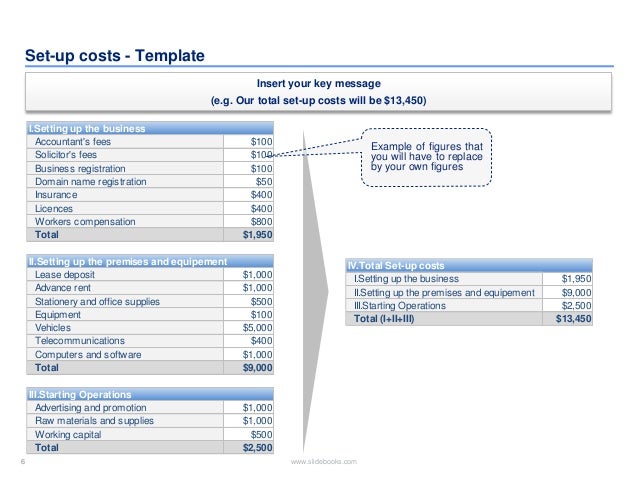
Image source: https://image.slidesharecdn.com/financialplanforsmallbusinesses-140502001433-phpapp01/95/financial-plan-training-and-templates-6-638.jpg?cb=1449365500

How Do You Set Consulting Fees

One of the most frequent questions I receive from those who are trying to start or grow their own consulting business is: "How and what do you charge clients for your consulting services?"

The ways of billing clients are numerous. There are hourly rates, by-the-job fixed rates, contingency or performance arrangements, flat fee plus expenses, daily fee plus expenses, and many other methods of charging for your consulting services. Which one is best?

Let us consider some ways of billing for your time.

1. Hourly or Daily Rate

Many consultants charge by the hour or day. To establish an hourly or daily rate, they try to calculate the number of billable hours in a year. Many hours will be spent marketing and in administrative and other functions, so this time is not chargeable to the client. As well, vacation time, holidays, sick days, and so on, can not be directly billed to the client.

Consultants, like other businesses, must charge enough to cover their overhead expenses and also earn a profit. If a consultant wants to earn twenty-five dollars per hour of working time, he (or she) might have to charge one hundred dollars per hour to the client. This assumes one half billable hours and fifty percent overhead and profit.

Your hourly or daily rate may be limited by what your competition charges, especially if you have not positioned yourself as different from them.

2. Fixed or Flat Rate

Some consultants charge by the job or a flat rate. For example, a tax consultant might charge three hundred dollars to prepare a tax return for you and your spouse, including an unaudited income statement for your business from information supplied by you. If the consultant takes only one hour to do this, he grosses three hundred dollars per hour. If, though, the tax consultant miscalculates the time required, he could take twenty hours to complete the job and make only fifteen dollars per hour.

Of course, consultants can also make a profit on the labour of their employees or subcontractors.

Many consultants claim to make more on a flat rate than on a hourly basis. Advantages include being able to give a quote to the client up front and less disputes on price (as the total bill was agreed upon in advance).

To protect yourself on flat rate assignments, always limit the scope of your engagement to something that you can calculate easily.

For example, if you are asked to give a quote for setting up a website for a business, you might break this project into smaller assignments.

First, you could give a quote for preliminary research and recommendations. Estimate the time required to meet with the client, learn about his business and goals, develop strategies and a budget, and prepare recommendations on how to proceed. Then, give the client a quote (perhaps in the form of a one page letter agreement or proposal). Upon acceptance of the offer by the client in writing, you may proceed with this phase of the project.

Some consultants collect one-half of their fee up front and half upon assignment completion for each phase of the consulting project.

If the client doesn't like your recommendations, at least you get paid for the work you did. Perhaps you can charge him to prepare alternative suggestions.

If your website project was not broken into smaller steps or assignments, you could find that you spent way more time on the project than anticipated.

Also, you might not find out until you present your bill for the whole project that your client won't pay, either because he is not satisfied with the results or because he is unable or unwilling to pay.

Breaking down a project into smaller assignments helps you estimate more accurately and limits your financial exposure.

3. Contingency or Performance Arrangements

Sometimes clients will ask you to become their partner. If you do, you are no longer an objective consultant.

What if your client asks you to do management consulting for twenty-five percent of the net profits? Will there even be any profit by the time he writes off his car, home office, entertainment, travel, wages to self and family members, and other expenses?

On the other hand, if you are a marketing consultant that is absolutely certain that you can increase a client's sales, you may feel confident charging a fee based on the increased sales volume of the client. Are you sure your client will co-operate with you in the attaining of this goal?

Some consultants charge a flat rate plus a percentage of ownership or profits for their services.

Fees based on contingency or performance arrangements are risky. Most consultants are better off charging a fair price for their services and leaving the risk of the client's business to the client.

4. Value Based Fees

Sometimes consultants can justify fees based on their value to the client. For example, if you save a client one million dollars in taxes, your fee may be higher than normal to reflect the value of the services rendered.

You might pay an accountant or lawyer a fee of fifteen hundred dollars based on time for certain tax related services. What would you be willing to pay to legally save an extra million dollars in taxes? Ten thousand dollars, one hundred thousand dollars, or more?

Can you apply this information to your own consulting practice? Is there some particularly valuable service that you can render that would justify premium rates?

Selasa, 17 April 2018

How do Search Engines work

How do Search Engines work

Image source: https://blogger.googleusercontent.com/img/b/R29vZ2xl/AVvXsEjmuBSS-lP-DG-JxDa_eLCm5XiihH_mmVHsg37QJrLB4axhmitTfLtNIa8r35Mu59H-5ZPJH0l5bVDljFV2S29RxgOMgrLyyDPJnOtLxUlsjjUWRV7qVGrzyPHK9phRA4nA8a3HgtUZcEPT/s1600/img006.gif

How do Search Engines work

We are very familiar with websites like Google, Yahoo, Bing.
We use these sites to get the information we need. As soon as we search for something, based on the keyword we use, we get results on the browser which are related to that keyword. So, in this way we see may websites which are matching to our keyword. The results are web pages and the box where we put the keyword is the search engine. Its known to everyone that among all the search engines, Google search is the number one. So all our effort goes for www.google.com so that our website appears on the first page. People hardly visits the 3rd or 4th page. So all eyes on the first page.
Search results

So how does these search engines work? The method is quite complicated. Thousands of skilled people are working round the clock using some powerful software and algorithms. All the search engines has powerful database where they keep all those images, videos and documents in a much arranged way. As soon as we search for something, matched images or content appears. For example, an image stored in the database has name, and if we enter a keyword with the same name, we will see that image along with the website that contain the page. This task of collecting data by the search engines from different websites is called crawling. To perform crawling all the search engines use a software/algorithm which is called search crawler. Different search engine has different search crawler name. For example, google named it googlebot, yahoo named it Yahoo! Slup while bing calls it bingbot(also known as msnbot). These bots visits all the websites and collect data continuously. When a website is visited by this bot, its considered that the website is being indexed by the search engine. Once a website is indexed, the keywords found on that website will be shown in the search result. However, the website might not appear in the first page rather it will be on later pages.

So the question is, how can that website will appear in the first or second page? It depends on many factors. One of them is the search crawler visit. The more frequently the search crawler will visit the website, more up front the site will be placed in search result pages. So this is the basic! The more frequently you will make the bot visit the targeted site the more front that site will be placed. This is called search engine optimization (SEO). There are 2 types of SEO. On-page and Off-page SEO. Both are equally important for optimization. So there you go, as soon as you open a new website your target should be how to make the site appear on the first or second page. To do so, you need to perform search engine optimization.

How Can You Become a Justine Consultant and Work Flexible Hours

How Can You Become a Justine Consultant and Work Flexible Hours

Image source: https://www.ahousefullofsunshine.com/wp-content/uploads/2016/08/Moms-who-earn-30K-FB-image-1024x536.jpg

How Can You Become a Justine Consultant and Work Flexible Hours

As a leading South African direct-selling company, Justine gives thousands of women the opportunity to start and run their own home based businesses and determine their own incomes. Their beauty products are specially developed for the South African customer for the harsh African weather conditions.

Justine South Africa merged offices with Avon and work on more or less the same principles, although Justine is proudly South African. As a widely known and used beauty and skincare product for the people nationwide, relationships between consultants and customers evolve to where the needs of the customer gets thoroughly understood.

So why would you want to become a Justine consultant?

There are many reasons to this question but the most attractive is the flexible hours and flexible income. Once you become a consultant you are your own boss, but yet you are not on your own when you get stuck, you will receive plenty of help from your business leader and sales manager to help you with ideas to grow your business. Should you need skincare training of the products, no problem, you will receive this for free.

What are the other benefits?

Working for yourself with flexible hours, it's usually the case that the more you work the more you get paid, however, with network marketing opportunities like this, it's working smart that counts and not always just working hard. Every category of products you sell, you receive a percentage of commission. On all skincare products you sell, you get 25% commission, that's R250 for every R1000 order.

Justine's products are of the highest quality and once you show someone the brochure, chances are they will place an order with you. The brochure and sales material are designed to show the products off and to help the customers decide what they need for their skin texture. The products basically sell themselves.

Your growth in this business is not restricted to only becoming a consultant, after 3 months of being a consultant you can apply to become a business leader. You will then be invited for an interview and after all is done and said you will be able to recruit consultants in your own network.

This is how you leverage your time, you help other people buy at discount or sell with commission the products they learned to love. You help them just as you have been helped and in turn you get compensated for up to 13.5% of their total sales. Let's look at this example, if you have 50 people in your team and they average sales of R1000 each, that's R50000 in sales and you get 13.5% commission which totals to R6750 per month commission for you.

So how do you become a Justine Consultant? Find a Justine Business Leader who have found success themselves and ask them to instate you as a consultant. The business leader will answer all the questions you may have and help you get started on your way to success.

How Can Companies Save Big on Recruitment

How Can Companies Save Big on Recruitment

Image source: http://sd.keepcalm-o-matic.co.uk/i/keep-editing-to-keep-your-jobs.png

How Can Companies Save Big on Recruitment

Although in present era most of the works in any company and small or large-sized organization is performed by machines and computers still nothing can replace human resources. Without skilled as well as unskilled human resources it will be difficult for any organization to complete daily work processes that help in generating profit for the organization. As we know different companies operating in varied industries have a different requirement. Therefore, a different set of skills are required in human resources, which make the operations of any organization smooth in long-run. Further, once machines of any organization become obsolete it can be replaced with new pieces easily; however, replacing human resources is a much difficult task.

It is very difficult to recruit and retain the human resource for performing any set of work. In this regard often companies fail to perform proper recruitment process and right person at the right place is not adjusted because of this reason companies suffer losses in long run. However, by hiring the services of specialist recruitment Sydney companies can get a complete solution for recruiting desired human resources. Following the advantages that companies operating in different industries can get by hiring services of top recruiting companies Sydney.

Right person at right job

It is a difficult task for business owners to decide whom they should assign any work. If the right person is not allocated to the right job it means errors, mistakes, the duplicity of work, and mishandling of machinery. None of the business owners would like to afford such things as it will cause loss of time as well as loss of other resources. If you are carrying business in Australia than reputed placement agencies Sydney can help you in finding right personnel that suits any particular job.

Retention of human resources

Once the recruitment process is completed the most important challenge that any organization faces is retention of the human resources. As every organization continuously look for the desired candidate for performing any particular job; therefore, the organizations try their best to pick up best employees of their competitors. In this regard, it becomes very important to retain the existing human resources whose productivity can increase the profitability of the organization. The top recruiting companies Sydney not only recruit the employees for their client but at the same time, they take care of retention of human resources.

Recruits both skilled and unskilled human resources

In any organization, whether it is delivering products or services to its targeted end-users it is essential to hire the services of both skilled and unskilled workers. However, how any organization can decide how much skilled and unskilled workers it is requiring. Further, the judging the level of skill of employees is yet another difficult task for any organization. If an organization unable to distinguish the amount of skilled and unskilled employees it is requiring it will suffer losses. Thus, to avoid such losses an organization needs the support of best recruitment agency in Sydney.

Increases the returns on investment of organizations

At times many business owners believe that paying placement agencies Sydney is a kind of unnecessary expenses. Further, the companies also believe that any placement agency cannot deliver the complete solution in recruiting and retaining existing employees. In addition, there are also some organizations in Australia, which believe that hiring any placement agency can become the cause of loss at the end of the year. However, all these things are just a myth as reputed placement agencies operating in Sydney are much competent in hiring best personnel for companies operating in different industries.

How can business owners judge the competency of any specialist recruitment Sydney?

Although one can find several recruitment specialists in Sydney it is very difficult to judge the competency of any such specialists. However, there are some key points that business owners can keep in mind to find best placement specialists in Sydney.

Recruitment consultant skills Sydney must be competent enough to understand the customized requirement of different companies operating in varied industries.

The placement agency should have better control and can understand the need of recruited employees so that recruited employees must get retained in respective companies.

The third and foremost key point that placement agency should take care is that it should offer result oriented job so that the profitability of clients should increase.

How to Create Online Promotions for a Digital Consulting Agency

Image source: https://www.power4consulting.com/Portals/13455/images/contractor-school-19-steps-and-strategies-for-a-lead-generation-website-...